| February
2018 Testing Update
Additional
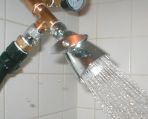
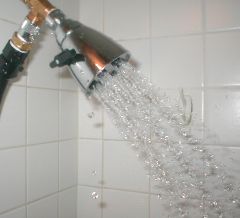
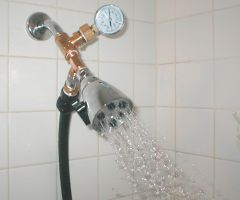
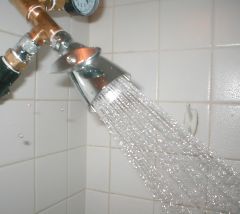
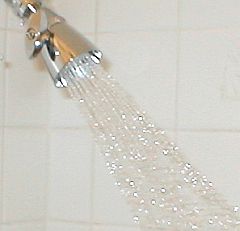
Flow photos are now available
here, showing spray pattern and stream quality. As mentioned
below, each flow photo was shot with the shower head's 2.5 gpm
flow restrictor installed, using a medium system supply pressure
of 60 psi, and using only the cold side of the water supply to
reduce steam in the photos. This means you can expect to see the
same high quality streams in your shower!
January
2017 Testing Update
Continuing
refinements were made to the testing methodology resulting in
very minor ratings changes for the rain shower head models, plus
the redesigned Luna and Perfect models were retested. See
the latest testing results
March
2016 Testing Update
Flow
photos of all shower heads are now available
here, showing spray pattern and stream quality. Each photo
was shot with the shower head's 2.5 gpm flow restrictor installed,
using a medium system supply pressure of 60 psi, and using only
the cold side of the water supply to reduce steam in the photos.
This means you can expect to see the same high quality streams
in your bath!
September
2015 Testing Update
Minor
refinements were made to the testing methodology to improve the
consistency between standard spray and massage spray measurements.
See the latest testing results
February 2015 Testing Update
After almost
10 years, we've updated our testing and pressure rating process
and for the last few months we've been busy refining it to incorporate
everything we've learned since we began evaluating shower heads
in 2005. The most visible changes are (1) separate ratings for
massage pressure and regular pressure, to help you find exactly
what you're looking for in a shower head, and (2) and improved
system for measuring pressure in products that are adjustable
from coarse to fine. Our new rating system is much more detailed
and we'll be sharing more of the behind-the-scenes details soon.
Over the next several months we'll begin posting videos of each
shower head undergoing the dreaded 20 psi torture test. (One
quick note - the new rating system and the old system are not
directly comparable, meaning you can't compare the scores from
one shower head measured via the old system with another shower
head measured on the new rating system.)
Shower Head Testing
Our
testing has shown that there are three main factors which determine
if a shower head will provide a powerful spray:
1)
Stream Integrity: Do
the streams of water stay cohesive with a precise, uniform and
symmetrical flow or are they inconsistent, random or even colliding?
Are there renegade streams plotting their own courses? Does
the stream pattern stay the same at very low water supply pressures?
2)
Flow Efficiency: Does
the shower head convert all the available water supply pressure
into shower head pressure? This is particularly important in
low water pressure areas.
3)
Spray Dispersion: Does
the shower head spray stay focused or does it disperse at a
wide angle?
Powerful,
soothing shower heads will excel in each measure, not just one
or two. A garden hose, for example, would have an extraordinarily
high flow efficiency but provide a lousy shower, while many shower
heads have the proper spray dispersion but provide poor flow efficiency.
Of the three measures, the first two are the most important and
very few heads perform well in both these measures.
Measuring flow efficiency and testing the integrity of the streams
at various lower pressures requires special test equipment.
We developed
this testing criteria with the goal of measuring shower head performance
in an objective way that exactly matched the practical but subjective
measure of how strong and powerful the streams feel in the shower.
After much trial and error, some head scratching and several equipment
redesigns, we arrived at our current methodology.
Testing
Photos
(Please
note these are our original testing photos from many years ago,
included here to help explain our testing methodology. For the
most recent testing photos (and much higher quality photography)
please see our current testing
photos here)
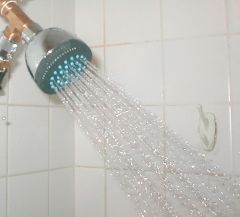
Stop-action
photography can reveal flaws and problems with streams that the
naked eye can't catch:
|